

Mitsubishi Air Conditioner: Is It Worth the Premium?
When people talk about premium air conditioning, the Mitsubishi air conditioner almost always comes up. Known for Japanese engineering, long-lasting compressors, and whisper-quiet operation, Mitsubishi has built a reputation as one of the most reliable AC brands in the world. But is it the right choice for your home or office, and how does it compare to more budget-friendly alternatives?
This guide breaks down everything you need to know about Mitsubishi air conditioners – their technology, product range, pros and cons, and how to decide if the premium price tag is worth it for your space. We’ll also look at how it stacks up against other major brands, what installation actually involves, and the questions most buyers ask before making a decision.
A Quick History of Mitsubishi’s HVAC Business
Mitsubishi Electric has been manufacturing air conditioning systems since the 1920s and has grown into one of the largest HVAC producers in the world, operating across residential, commercial, and industrial cooling. Two related brand names often cause confusion: Mitsubishi Electric, which focuses heavily on inverter split, duct, and VRF systems for homes and businesses, and Mitsubishi Heavy Industries (MHI), a separate company that also produces air conditioners, sometimes under the “Mitsubishi Heavy” or, in some markets, joint-venture branding. Both have strong reputations, but it’s worth checking which entity manufactured the specific unit you’re considering, since warranty terms and service networks can differ between them.
Why Mitsubishi Air Conditioners Are So Highly Rated
- Build quality and durability – many units run reliably for 15+ years with proper maintenance, thanks to tightly controlled manufacturing and premium internal components
- Quiet operation – among the lowest noise levels in the industry, with some indoor units operating below 20 decibels on low fan speed, ideal for bedrooms and quiet workspaces
- Advanced inverter technology – Mitsubishi’s inverter compressors adjust speed continuously rather than cycling on and off, giving precise temperature control with minimal energy waste and fewer temperature swings
- Strong cooling in extreme heat – engineered to maintain performance even in high ambient temperatures, which matters in Gulf climates where outdoor units can face 45°C+ conditions for months
- Long-standing brand reputation – decades of HVAC manufacturing experience in Japan, backed by rigorous quality testing standards
- Air quality features – many models include multi-stage filtration, dehumidification modes, and self-cleaning functions that reduce mold and odor buildup inside the unit
- Smart controls – Wi-Fi-enabled models allow remote scheduling and monitoring through a mobile app, and many integrate with popular smart home platforms
Types of Mitsubishi Air Conditioners
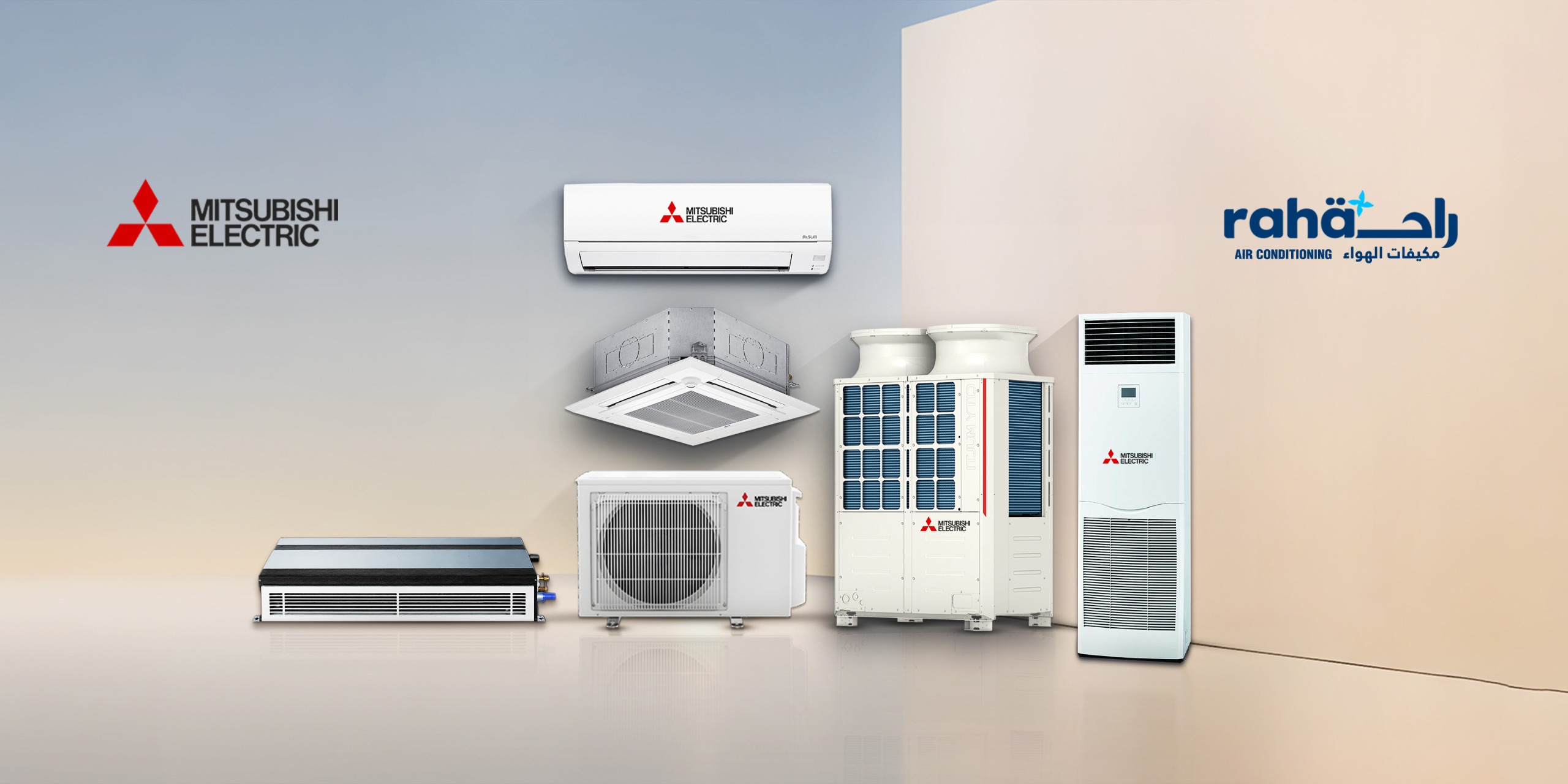
Split AC
The standard choice for individual rooms, offering quiet indoor units and efficient inverter compressors – a strong option for bedrooms and small offices. Mitsubishi’s split units are typically available in a range of capacities from around 0.75 to 3+ tons, with high-end lines offering features like 3D airflow control, plasma air purification, and coanda airflow that spreads cool air across the ceiling before it descends, reducing direct drafts on occupants.
Duct AC
For homes and offices wanting concealed, central cooling across multiple rooms, Mitsubishi’s ducted systems are a popular choice in premium villas and commercial fit-outs where noise levels and long-term reliability matter most. These systems typically offer static pressure options that let installers route ductwork over longer distances without losing airflow performance, which is useful in larger properties with complex ceiling layouts.
Cassette AC
Installed in false ceilings for even, 360-degree airflow – commonly used in offices, showrooms, and larger commercial spaces. Cassette units are especially popular in retail and hospitality settings because they blend into the ceiling design while still delivering strong, uniform cooling across an open floor plan.
VRF (Variable Refrigerant Flow) Systems
Mitsubishi is one of the pioneers of VRF technology, allowing a single outdoor unit to serve multiple indoor zones with independent temperature control. This makes it a top choice for large villas, hotels, and commercial buildings needing flexible, efficient multi-zone cooling. VRF systems also simplify future expansion, since additional indoor units can often be added to an existing outdoor unit’s capacity without a complete system overhaul.
Key Considerations Before Buying
- Upfront cost – Mitsubishi units typically sit at the higher end of the price spectrum
- Cooling capacity – get a proper load calculation to match tonnage to your room size
- Installation quality – even premium units underperform with poor installation, so use certified technicians
- Warranty and service network – check local availability of spare parts and authorized service centers
- Long-term savings – higher efficiency can offset the higher purchase price over the unit’s lifespan
Mitsubishi vs. Other AC Brands
Mitsubishi generally outperforms mid-range brands in noise levels, build quality, and long-term durability, which is why it commands a premium price. That said, brands like LG and Samsung offer strong smart features at a lower cost, while more budget-focused brands like Midea and O General deliver dependable performance – especially in hot climates – at a significantly lower price point. If your budget doesn’t stretch to Mitsubishi but you still want reliable, inverter-based cooling, Raha Home in Qatar offers genuine Midea and O General units that are well-suited to the region’s climate at a more accessible price.
What Installation Actually Involves
Installing a Mitsubishi air conditioner, especially duct, cassette, or VRF systems, is more involved than a basic split unit and typically follows these stages:
- Site survey and load calculation – a technician assesses room sizes, insulation, sun exposure, and occupancy to calculate the correct tonnage and unit configuration
- System design – for ducted or VRF setups, this includes duct routing, vent placement, and refrigerant piping layout, usually planned around the false ceiling
- Outdoor unit placement – positioned with adequate airflow clearance and, ideally, some shade to improve efficiency in hot climates
- Indoor unit and ductwork installation – mounted and insulated according to manufacturer specifications to minimize energy loss
- Refrigerant charging and pressure testing – critical for performance and long-term compressor health; incorrect charging is one of the most common causes of early AC failure
- Commissioning and handover – the system is tested across cooling modes, and the installer should walk you through basic operation, filter locations, and maintenance schedules
Because premium units are only as good as their installation, it’s worth confirming that your installer is certified and experienced specifically with Mitsubishi systems, not just AC installation in general.
Cost vs. Long-Term Value
Mitsubishi air conditioners typically cost more upfront than mid-range brands, sometimes 20-40% more depending on the model and capacity. That said, the total cost of ownership can look different once you factor in:
- Lower electricity bills from high-efficiency inverter compressors, particularly noticeable in regions with long, hot cooling seasons
- Fewer breakdowns and repairs over the unit’s lifespan, thanks to stronger build quality
- Longer replacement cycles – a unit lasting 15+ years versus 8-10 years effectively spreads the higher purchase price over more years of use
- Resale and property value – premium HVAC brands are sometimes viewed favorably in real estate listings, particularly for villas and high-end apartments
Whether this trade-off makes sense depends on how long you plan to stay in the property, your local electricity rates, and how much you value quiet, consistent performance day to day.
Maintenance Tips for Mitsubishi AC Units
- Clean filters every 4–6 weeks, especially during peak summer use
- Book annual professional servicing to inspect refrigerant levels and coil condition
- Keep the outdoor unit clear of dust, debris, and direct obstruction
- Avoid extreme temperature settings for extended periods to reduce compressor strain
- Use a stabilizer in areas prone to voltage fluctuations
Frequently Asked Questions
Is Mitsubishi a good brand for air conditioners? Yes. Mitsubishi is widely regarded as one of the most reliable premium AC brands, known for durability, quiet operation, and efficient inverter technology.
Why is Mitsubishi AC so expensive? The higher price reflects premium build materials, advanced compressor technology, stricter quality control, and a longer expected lifespan compared to many mid-range brands.
How long does a Mitsubishi air conditioner last? With regular maintenance, Mitsubishi units commonly last 15 years or more, often outlasting mid-range alternatives.
Are there good alternatives to Mitsubishi at a lower price? Yes. Brands like Midea and O General offer strong inverter performance and reliability at a more affordable price point, particularly suited to hot climates like Qatar. Raha Home is a trusted local dealer for both.
What’s the difference between Mitsubishi Electric and Mitsubishi Heavy Industries? They are separate companies that both manufacture air conditioners under related branding. Mitsubishi Electric is generally more associated with residential and light commercial inverter systems, while Mitsubishi Heavy Industries has a broader industrial and commercial HVAC portfolio. It’s worth confirming which one manufactured your specific unit, since service networks and parts availability can differ.
Does a Mitsubishi AC need a special installer? While any qualified HVAC technician can physically install the unit, it’s best to use an installer with specific experience on Mitsubishi systems, since incorrect refrigerant charging or ductwork sizing can significantly reduce efficiency and shorten the compressor’s lifespan.
Final Thoughts
A Mitsubishi air conditioner is an excellent investment if you prioritize long-term durability, ultra-quiet performance, and premium build quality – and are willing to pay for it. If your budget is more flexible toward value-for-money options, exploring alternatives like Midea or O General is worth considering before you decide.
Looking for a reliable, budget-friendly alternative in Qatar? Raha Home offers genuine Midea and O General air conditioners with professional installation and after-sales support.
Leave a Reply